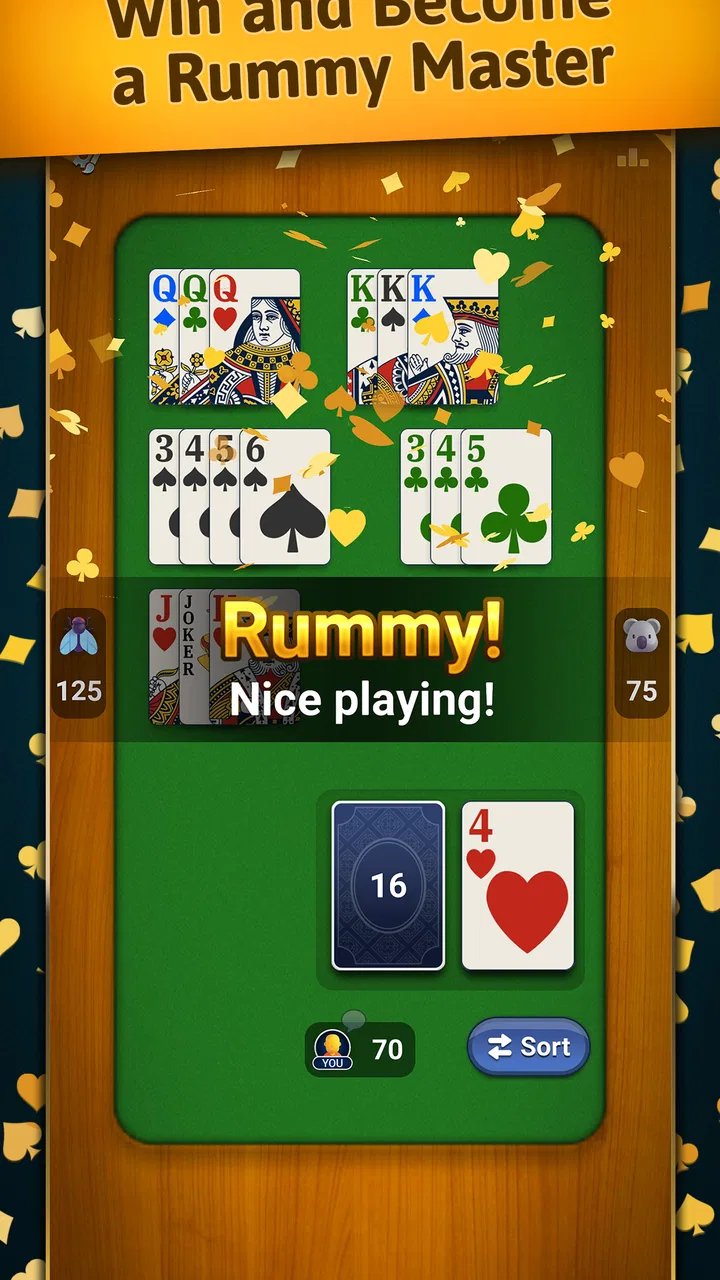
Rummy - Classic Card Game
- 4.6
- Rating
- 1.00M
- Installs
- Free
- Price

 Analysis by App-foxy
I have always liked card games that are easy to start but still leave room for a clever decision, and Rummy - Classic Card Game fits that space well. It takes the familiar rummy format and turns it into a compact mobile game from MobilityWare, with a focus on arranging your hand, spotting useful combinations, and deciding when to stop holding back. I found it comfortable for short sessions, although its appeal depends heavily on whether you enjoy repeating a traditional card format rather than chasing a large collection of modes.
The game is free to download and suitable for Everyone, which makes it approachable for family use and casual players. It has reached over 500 thousand installs and holds a 4.7 average from around 18 thousand ratings, so it has clearly found an audience beyond people who only play rummy once in a while. The current release is version 1.3.8.1668, and it runs on Android 8.0 or later. Optional purchases range from $4.99 to $29.99 per item, something worth remembering if you prefer to keep a completely free gaming routine.
How the first games establish a rhythm
The opening appeal is immediate: you receive cards, look for sequences or groups, and try to organize the hand before the other side does. That basic loop is much easier to understand than a strategy game with a long tutorial, but it is not mindless. Every draw changes the value of what you are holding, and a card that looks useless at one moment can become important after a single turn.
You May Also Like

 Blood Strike: 2.5 Anniversary
Blood Strike’s Loadouts Turn Every Drop Into a Tactical Gamble
A close look at Blood Strike’s custom loadouts: how fast access to signature weapons reshapes its battle royale rhythm, rewards preparation, and narrows the gap between fights.

 Pandora - Music & Podcasts
Pandora’s Music Is Easy to Start, but Harder to Recover
Pandora’s strength is its low-effort path from a seed to a station. Its weak spot is how much confidence it asks you to place in connection, setup, and quiet recovery.

 8 Ball Pool
 Is Built on Rivalries, Rematches, and Routine
A close look at the rivalries, rematches, shared routines, and unanswered safety questions that turn a quick pool match into a persistent mobile community.

 Samsung Music
’s Quiet Strength Is Playing What You Already Own
Its reach comes less from spectacle than from dependable access to a personal library. That simplicity is both the app’s strongest retention engine and its ceiling.

 AccuWeather: Weather Radar
AccuWeather Review: A Quick, Clear Forecast for Everyday Decisions
For everyday plans, the best forecast is the one you can understand quickly. AccuWeather makes rain timing, radar, and local conditions easy to act on, with a few trade-offs.

 Hill Climb Racing
Why Hill Climb Racing Still Turns Crashes Into One More Run
A tiny car, a bumpy hill and one more upgrade: Hill Climb Racing keeps resurfacing because its simple chaos makes every near-miss feel personal.
More From Our News Desk



My first useful adjustment was to stop treating every card as equally valuable. A pair can be promising, but keeping it too long may prevent you from building a more flexible run. Likewise, a high card can be worth discarding early when it is not connecting with anything. The game works best when I make these small judgments quickly instead of waiting for a perfect hand.
The early goal is not simply to win one round. It is to learn the pace of the table: how quickly cards move, how much information can be inferred from discarded cards, and when a hand is becoming too awkward to repair. That learning process gives the first sessions more purpose than the simple rules might suggest. I was not unlocking a complicated world; I was improving my reading of the hand itself.
That distinction matters. Players who expect a large campaign, character upgrades, or a story may find the opening too plain. Players who enjoy traditional card play will probably appreciate that the game gets to the point without surrounding rummy with unnecessary decoration. It is a focused experience, and its first test is whether the act of sorting possibilities feels satisfying to you.
Small decisions matter more than fast tapping
Mobile card games can sometimes feel like they reward speed, but this one is better approached as a thinking game. I found it useful to pause briefly before drawing or discarding, especially when several cards looked almost useful. The important question is not only “What can I make now?” but also “Which card gives me the most ways to improve on the next turn?”
A practical routine is to separate your hand mentally into three groups: cards already forming a likely combination, cards that could connect in more than one direction, and cards with no clear purpose. The middle group deserves the most attention. Discarding a completely isolated card is often safer than breaking a flexible possibility, even when the isolated card has a higher face value.
Jokers add another layer to that early decision-making. Because they can help complete combinations, using one immediately is not always the best move. I preferred to keep a Joker available when my hand had several near-complete options, but I would not hold it forever if doing so blocked a clean finish. The useful lesson is that a powerful card can become a source of hesitation; it is valuable because it creates choices, not because it should automatically be saved.
This is one of the game’s strongest early goals: learning to turn a messy hand into a plan. There is no need to memorize a large rulebook, but there is a real difference between making a legal move and making a sensible one. That gap gives the classic format enough depth to support repeated play.
Progress signals without a complicated progression system
The sense of progress here comes mainly from better decisions and more confident rounds. I noticed improvement when I began recognizing dead cards earlier, protecting flexible combinations, and judging the right moment to go out. Those are subtle signals, but they are meaningful because they directly change how a hand feels.
This is not the kind of game where I needed a long checklist of upgrades to stay interested. The reward is seeing a position that once seemed confusing become readable. A hand with scattered cards can still offer a route forward if I examine the gaps carefully. When that route works, the satisfaction comes from solving the arrangement rather than collecting an item.
For a new player, I recommend setting personal goals instead of waiting for a large external progression track. Try to reduce unnecessary discards, avoid holding disconnected high cards, or finish a round without using a Joker unless the hand truly requires it. These goals make ordinary matches feel more deliberate and provide a way to measure improvement without inventing pressure that the game does not need.
There is also a useful difference between winning through luck and winning through preparation. A strong opening hand makes life easier, but it does not remove the need to manage the next draw. A weak hand can sometimes be rescued by keeping several possible connections alive. I enjoyed that the game gave me reasons to review my choices after a loss instead of assuming the result was entirely random.
At the same time, the progress signals are limited if you need visible long-term rewards. The traditional structure does not automatically provide the same motivation as a collection game, a ranked ladder, or a campaign with new abilities. I would recommend it to someone who considers skill refinement a reward in itself. If you need frequent unlocks to justify another session, the experience may lose its pull sooner.
How to make a short session feel worthwhile
A realistic use case is a ten-minute break while waiting for an appointment or commuting as a passenger. I can open the game, play a small number of rounds, and stop without feeling that I have abandoned a complicated mission. That makes it more practical than a card title that demands a long uninterrupted session.
For those short sessions, I found it better to choose one focus before starting. For example, I might concentrate on discarding isolated cards quickly, or on keeping two possible runs open. This prevents a brief match from becoming a blur of automatic taps. It also turns the game into a small mental exercise rather than background noise.
Another useful habit is to examine the discard pile before committing to a combination. A card that would complete your run may already be less likely to appear if several copies have passed through play. That does not make the draw predictable, but it improves the quality of the decision. Rummy rewards attention to what has already been revealed, and the mobile format makes this easier to practice because the information stays visible during the round.
I also learned not to chase every possible combination at once. Keeping too many ideas alive can leave the hand crowded with cards that are individually attractive but collectively unhelpful. Choosing one main route and one backup route usually felt more productive. This is a small but important trade-off: flexibility helps early, while commitment becomes more valuable as the hand develops.
Difficulty, tension, and the changing value of time
The difficulty curve is gradual in a way that suits a classic card game. The rules remain approachable, but the decisions become more demanding as I stop making obvious mistakes. At first, I mainly looked for completed groups. Later, I paid more attention to timing, discarded information, and the risk of giving another player a useful card.
The tension rises naturally when the opponent appears close to finishing. At that point, a slow improvement plan may no longer be good enough. I may need to break a promising combination, discard a risky card, or use a Joker earlier than planned. This gives the final part of a round a different character from the opening: early turns are about building options, while late turns are about choosing which option can actually survive.
One of the most important trade-offs is between keeping a high-value card for a possible combination and removing it before it becomes a liability. New players often wait because the card might become useful. I found that this can be costly when the hand is not improving. A card with potential is not automatically a good card to keep; its value depends on how many realistic paths connect to it.
The game is also a reminder that a Joker can hide a weak structure. It may complete a combination and make the hand look healthy, but the remaining cards can still be poorly connected. I started checking the whole hand after using one rather than assuming the problem was solved. That simple check helped me avoid spending a flexible resource on a combination that did not bring me much closer to going out.
For experienced rummy players, the challenge may feel familiar rather than revolutionary. That is not necessarily a flaw. The appeal is in the clean repetition of a known format, and the difficulty comes from making sharper choices inside that format. Someone searching for unusual rules or a dramatic competitive ladder should look elsewhere; someone wanting a polished way to revisit classic rummy will find more to work with.
Where the pacing works and where it can drag
The pacing is strongest when the hand changes meaning from turn to turn. A new draw can open a run, force a discard, or make an earlier plan obsolete. Those moments kept me engaged because I was constantly updating my priorities rather than following a fixed sequence.
The slower moments appear when the hand contains several cards that are unlikely to connect and the next useful draw does not arrive. That is part of rummy’s nature, but on a phone it can feel more noticeable because the surrounding experience is intentionally restrained. I would not choose this game when I want constant action. It is better for a calm, attentive mood where a little waiting is acceptable.
A good way to handle a stalled hand is to stop trying to preserve every previous decision. If the original plan depends on one specific card, it may be time to rebuild around a different group or sequence. I found that accepting a partial reset was less frustrating than repeatedly protecting a combination that had stopped developing. That approach also makes losses more informative.
The game’s pacing makes it suitable for different levels of attention. I can play casually while relaxing, but the best rounds reward giving the hand my full focus. If I am distracted, I am more likely to discard a card that could help later or miss what the discard pile is telling me. The game does not require intense concentration every second, yet it does punish careless autopilot more than many simple card apps.
Retention pressure and the free-to-play question
The free entry point is a clear advantage. I could try the core card experience without paying first, which lowers the risk for anyone who is unsure whether classic rummy will hold their attention. The optional purchase range, from $4.99 to $29.99 per item, means it is sensible to review the purchase screen carefully and decide in advance whether you want to spend anything.
I prefer treating the game as a self-contained card break rather than something I must keep up with every day. That mindset reduces pressure and makes the wins feel more natural. If the game encourages you to return through goals or challenges, the healthiest way to use them is as optional structure: play when you want a round, not because you feel forced to maintain momentum.
This is also where the title may divide players. A person who enjoys the steady habit of familiar matches may find the repeatable format relaxing. Another player may feel that the lack of a larger variety of activities limits long-term retention. The game’s staying power depends on whether improving your rummy judgment is enough motivation on its own.
For families, the Everyone age rating makes the game easier to consider as a broadly accessible card option. Still, I would explain the in-app purchase setup before handing a device to a younger player, especially if the device has a stored payment method. The free download is convenient, but free does not mean every optional item is free.
I would also skip it if your main reason for downloading a card game is social competition with friends. This experience is more attractive when you want a focused rummy session than when you need a party game, a broad multiplayer hub, or a constantly changing set of events. A dedicated online card platform may be a better match for players who value direct competition and a larger community structure above all else.
Who should choose this over other card apps?
Compared with solitaire, this game gives me more interaction with the changing hand and more reason to consider what another player might need. Solitaire is often better for a quiet puzzle with a very simple objective, while rummy is stronger when I want decisions about risk, timing, and discarded information.
Compared with elaborate collectible card games, this title is much easier to enter. There are no complicated decks to build or large sets of rules to study before a match can make sense. The trade-off is that it does not offer the same sense of discovery, customization, or strategic variety that a deck-building game can provide.
Compared with playing physical rummy around a table, the mobile version is more convenient and consistent for a quick solo session. I do lose some of the social warmth and conversation of playing with other people. For me, that means the app is a useful substitute when nobody is available, but not a replacement for a friendly card night.
Its strongest audience is therefore quite specific: people who already like rummy, newcomers who want a low-barrier card game, and anyone looking for a short mental break with more substance than tapping through a passive puzzle. It is less convincing for players who need a story, a large progression map, or constant novelty to stay engaged.
My verdict after looking at the full play loop
MobilityWare has kept the focus where it belongs: on reading the hand, building combinations, managing Jokers, and choosing the right moment to go out. The early goals are simple, but the game gives them depth through small decisions. Progress is felt through improved judgment rather than a noisy reward structure. The difficulty grows as I become more aware of timing and risk, and the pacing works best when I approach each round as a compact problem to solve.
The limitations are just as clear. Traditional rummy can become repetitive if the format itself does not appeal to you, and the slower turns may feel flat when you want action. The free-to-play model also deserves attention because optional items cost between $4.99 and $29.99, even though the game itself can be downloaded without an upfront charge. Players seeking a broad social platform or a rich collection of unlockable content may prefer another card category entirely.
For my own use, I would keep it installed as a dependable short-session game. It works especially well when I have a few minutes, want something familiar, and still feel like making real choices. My best advice is to play actively: watch the discard pile, keep flexible options alive early, abandon weak plans before they consume the hand, and do not treat every Joker as an automatic solution.
The progression verdict is positive but deliberately modest: the game sustains play through the satisfaction of getting better at rummy, not through a large adventure-style system. If that kind of progress is enough for you, this is an enjoyable and accessible choice. If you need constant unlocks, social competition, or dramatic changes from one session to the next, I would choose a more feature-heavy alternative instead.
FAQs for Rummy - Classic Card Game
01What are the main features of Rummy - Classic Card Game?
Rummy - Classic Card Game offers a sleek and user-friendly interface with multiple game modes, including multiplayer and solo play. It supports various versions of Rummy, such as Gin Rummy and Indian Rummy, and provides daily challenges and rewards. The game also includes tutorials for beginners, making it accessible for all skill levels.
02Is Rummy - Classic Card Game free to play?
Yes, Rummy - Classic Card Game is free to download and play. However, it does offer in-app purchases for additional features, such as premium avatars, exclusive tables, and ad-free experiences. These purchases are optional and not necessary to enjoy the core gameplay.
03Can I play Rummy - Classic Card Game offline?
Rummy - Classic Card Game offers both online and offline modes. You can play against AI opponents without an internet connection, making it a great option for travel or areas with limited connectivity. Online mode allows you to compete with players worldwide, enhancing the competitive aspect.
04How do I ensure fair play and security in Rummy - Classic Card Game?
The game uses advanced algorithms to ensure fair play, and all transactions are secured with encryption. Players are encouraged to report any suspicious activity. The game also has a robust player reporting system and community guidelines to maintain a safe and enjoyable environment for everyone.
05What devices are compatible with Rummy - Classic Card Game?
Rummy - Classic Card Game is compatible with most Android and iOS devices, requiring at least Android 5.0 or iOS 10.0. It is optimized for both smartphones and tablets, providing a seamless experience across all devices. Check the app store for specific device compatibility details.
Pros
- Smooth and intuitive user interface.
- Variety of game modes available.
- Includes a tutorial for beginners.
- Low data consumption during play.
- Regular updates with new features.
Cons
- Contains in-app purchases.
- Advertisements can be intrusive.
- Requires internet connection.
- Limited offline functionality.
- Occasional connectivity issues.

Rummy - Classic Card Game
Gallery